Thursday, November 19, 2009

Insurer's CRE Exposure

Fitch (sorry no link) noted that:

...Despite a declining outlook for all US CMBS property types and an escalation of losses, the U.S. life insurance sector should be able to manage its exposure to commercial real estate-related losses...

While most life insurers have yet to recognize material losses on their commercial real estate-related investments, a sizeable portion of their assets are entrenched in commercial real estate. And with an increasingly negative outlook in the cards for CMBS over the next couple of years, performance pressure on life insurers is likely to increase over time.

'Commercial real estate (CRE) fundamentals are softening as rents are declining and vacancies increasing in response to the broader economic downturn,' said Managing Director Bob Vrchota of Fitch's CMBS ratings group. 'Without a recovery for commercial real estate fundamentals, recent vintage U.S. CMBS could experience losses averaging 8.7%.'


Some insurers are better off than others. Take Hartford, for instance - not to single any particular firm out, but they had 33% of their structured products portfolio in securities rated lower than AAA at issuance. Virtually all of that has been downgraded to something lower than A-rated today, and thus their RBC ratios have to be shooting through the roof. In addition, about 70% of their structured products portfolio was 2005 vintage or later, i.e. weaker underwriting. According to a 10/24/08 report from Citi, Hartford and XL had the largest CMBS investments of all the Insurers they covered, Hartford had the lowest quality CMBS portfolio (followed by Progressive and AIG), Hartford and Progressive had the highest concentration of IOs, Hartford had the largest CRE CDO exposure (12.3% of shareholder's equity at the time, and 13.1% of their CMBS portfolio) and 11% of them were rated below BBB at the time.

The last stament in the Fitch report that CMBS could experience losses averaging 8.7% seems a little rosy - that is closer to the low-end estimate of average losses in my opinion, and is in line with the average losses experienced during the late 80s/early 90s on senior CRE mortgages. The good news is that most insurers were relatively conservative investors, and further they tended to be CRE guys first, and bond guys second. So, overall I wouldn't expect to see horrible losses in their CMBS portfolios over the long-term.

DDR 2009-DDR1 - Good for the borrower, bad for the investor

ZH sums it up.

Wednesday, November 18, 2009

Simon and GGP Marriage - With wedding photos and charts

What would this look like?


Something like the above, where the little rusty-red dots are GGP and the Blue dots are SPG. Note that I think the "CUBA" property is really in Italy and the GEO-Coder misinterpreted it - you can click here for an interactive map that includes all their properties, not just domestic.

GGP has substantially lower coupons on their mortgage debt, averaging 63 bps lower @ 5.29%, but the divide is even larger on loans maturing before the end of 2012, favoring GGP by an average of 125 bps. So, given everything else remains the same, Simon will be likely to assume GGP's mortgage loans. Add in factors such as the lack of available financing, higher coupons, stricter underwriting, etc. SPG's only roadblock to assuming the mortgage debt is getting rating-agency sign-off where its required.

GGP's mortgages on their malls actually perform slightly better than Simon's from a cash flow over debt service perspective. The majority of GGP's malls have a NCF DSCR greater than 2x. Simon's average DSCR is 1.83x.

GGP properties also have slightly lower leverage, with average original LTVs at 62.72% versus SPG's average orig. LTV of 66.53%.

Obviously GGP has a lot more overall debt (mortgage and corporate) due to the Rouse acquisition, and we all know about their huge refi hurdle - look below. This is the maturity schedule, in billions, for all GGP and SPG CMBS mortgages, extended out to their maximum ARD or Extension date.


The footprint overlap is probably of some concern that might lead Simon to cherry pick assets instead of taking the entire platform down. Some MSAs have multiple properties operated by each REIT.

Take Atlanta-proper, for instance. SPG has Phipps Plaza, Lenox Square, and Northlake, while GGP has Cumberland and Perimeter; if you expand to the Atlanta MSA, you end up with SPG malls Discover Mills, Gwinnett Place, Town Center at Cobb, Mall of Georgia, Mall of Georgia Crossing, North Georgia, and GGP has North Point and Southlake. Not only is there a high number of malls in the Atlanta MSA from both sponsors, but a quick look at the loans and the GGP Atlanta loans are higher leveraged then average (so are the SPG loans), and have lower DSCRs than average.

Tenant overlap is pretty consistent, just looking at the non-anchors, and focused on revenue, Simon has a slightly more diverse tenant base.

Top Retail Tenants by Rental Income Simon GGP
The Gap 2.20% 2.90%
Limited 2.00% 2.60%
Abercrombie & Fitch 1.80% 2.30%
Foot Locker 1.40% 2.30%
Zale 1.00% <1%
Luxottica Group 1.00% <1%
American Eagle 0.90% 1.50%
Express 0.90% 1.30%
Sterling Jewelry 0.90% <1%
Genesco 0.80% 1.10%

Not sure who wins the battle of increased tenant concentration - probably the tenants since they have more negotiating power, but could go to the landlords because the tenants have fewer location options.

Will be interesting to see if Simon cherry picks the performing assets and let's the others (especially in high-overlap areas) flounder, or if they go in and take it a substantial percentage of the total to increase their footprint and dominate the space (as if they don't already) blocking out any competitors.

Tuesday, November 17, 2009

ESH Ruling Problematic?

Moody's pondered that the Judge's ruling in the ESH bankruptcy case that the actual investor list be released so he could hear their concerns directly (versus through the Trustee/Servicer)

Moody’s noted it cautioned in June this scenario might lead to “free-for-all financing” as certificate-holders plead their own cases, bypassing the natural filtering process of the trustee and servicers. Because of the implications, Moody’s said at the time any judge would be unlikely to pursue that option.

“Judge [James] Peck may return to his initial skepticism and rule on later substantive motions the way all market participants, even the certificateholders now attempting opportunistically to bypass the trust structure, thought the rules would work when the ESH transaction went out the door,” Rubock said. “Or me may not, and we may need to rethink how robust many structures are — from trusts to participants — under the extreme tests to come.”


Probably not a big deal at this stage, but maybe it sets a new precedent for other workouts down the road.

Chicken and Egg - Bailout and Crisis?

A friend of mine has been sending me depressing stories all morning from the Huffington Post. I don't know if he needs a hug and is reaching out for attention, or if things are just this bad - there's an article about a kid in Michigan who is being denied a prosthetic arm by his insurance company, another about no more raw oysters, another about Al de Molina stepping down (oh wait, this could be GREAT news for BOA in Charlotte). Anyways, they linked to a, mostly factual, slide show from business insider that blames the regulators for the crisis....

UPDATE: I finished the article and decided its stupid and you shouldn't read it.

How A Government Bailout Created Today's Commercial Real Estate Catastrophe


Wait, only the first 1 or 2 slides are mostly factual, then John Carney just starts making things up. The size of the market is wrong, RTC did not "Create" the CMBS market, then he blames Basel I risk-based capital reserves, 60% of CRE mortgages were securitized (try 28%, at the height of the market!), that because of the CMBS market the remaining bank mortgages were the riskiest loans (instead of pointing out that C&D loans were always the riskiest, and he pointed out earlier that these were the primary loans that banks made before CMBS), next he blames REITs, dot com bubbles, and it goes on. I clicked through a few more slides, and its all just misguided garbage. He continues down this path that small banks have risky loans on their balance sheets because they securitized their good loans - small banks didn't securitize any CRE loans, they just originated 100% of the C&D and land loans.

You know what, don't read it. It's so misguided.


Monday, November 16, 2009

FAS 166 & 167 Implications

A topic that I've referenced many times, but have yet to do a complete overview of is FASB's idiotic accounting rules. Barclay's (Hotel Tango ZH) looked at the impact to various banks by primarily looking at nonconforming resi, Credit Cards, and ABCP (It sounds to me like the rules encompass more products than that, but hopefully I'm wrong). Please read the whole article from ZH - I won't take it whole cloth.

This will have the impact of increasing asset levels and possibly reduce retained earnings--both which adversely impact capital ratios. Note consolidation results in an increase in loans and leases, securities, short-term borrowings and long-term debt on the banks’ balance sheets. In addition, there could be a cumulative effect of adopting these new accounting standards resulting in a charge to retained earnings relating to the establishment of loan loss reserves and the reversal of residual interests held. Additionally, limiting banks ability to recognize securitized assets as off-balance sheet exposures could have further consequences on credit creation.


DDR 2009-DDR1 Priced

Tranche Size Coupon Rtg Talk Price
A $ 323.50 4.28% AAA N+145-160 N+140
B $ 41.50 7.45% AA

C $ 3.00 8.43% A


Don't have any additional details. Seems uber-rich to me.

Coming and Going

DDR might get priced today. I think PIMCO summed it up best:

"It's a great execution for the borrower," says Scott Simon, managing director and head of mortgage- and asset-backed securities portfolio manager at Pimco, a leading bond house. "If other real-estate investors can borrow money at that rate, it would be a real game changer for the commercial real-estate market that has been so devoid of financing."
I wouldn't buy it at a 4% yield. However, the new issue machine has officially had most of the dust bunnies blown off and someone flipped on the switch. It's not just Goldman taking the leap, JP Morgan has started warehousing loans for an issue scheduled for early next year. I'm sure others have started to test the water as well.

Spreads responded positively. Spreads on the A4 class have tightened over 100 bps since their wide during the first week of the month.


Thursday, November 12, 2009

DDR 2009-DDR1

DDR 2009-DDR1 ($400mm)

Tranche Size Coupon Rtg Talk
A $350.0 4.28% AAA N+145-160
B $ 30.0 7.45% AA
C $ 33.0 8.43% A


I'll update with any color.

UPDATED PRICE TALK, again.

Wednesday, November 11, 2009

TALF changing to SUC OFF

Anonymous Banker has a good point. TALF doesn't really solve any problems. It doesn't matter if you're talking about new issue or legacy, TALF will not be the savior. It is riddled with issues that hinder its own success.

A) Diverse Collateral - unless the FRBNY looks the other way, the DDR deal is simply not diverse. It is 100% one sponsor, and 100% retail. The deal makes sense - we should support loans to institutional quality collateral, even when the sponsors have a BB+ rating, but this deal does not pass the diversity test. (Fortress likely passes, but the other deals in the pipeline don't pass this test either)

B) Failure to Specify TALF Eligibility Requirements - They've basically said, hey, we'll fund it as long as it is AAA and diverse, but we may reject it anyway. So, investors have to buy the bond with the added risk that they may be stuck with it and no TALF loan to leverage it (and a lower price b/c the NYFRB will immediately tell everyone they rejected it). It's the equivalent of telling your assistant to get you a triple-venti non-fat latte, and then throwing it in her face when she gets back from running down the street in the rain because the cup had a black lid instead of white one.

And more specifically to AB's point - what does TALF do to restart the loan market? CMBS was only about a quarter of the CRE lending market to start with, and it's maturity problems are mostly down the road 7+ years, unlike banks. Someone needs to step up and provide some very concrete guidelines and give the market some confidence.

-Stop all this FASB nonsense - just come up with a set of rules and implement it. Preferably stick to rules that aren't stupid like most of your recent changes.

-Stop all this talk about requiring issuers to retain an interest in securities - this already existed (see ABS Auto deals, or Specials on CMBS deals) and it doesn't solve the problem. "Hi, I'm XYZ 2009-1 and the government requires me to retain 10% of the deal on my books, so I'm going to increase some other costs by 10% and value that at near $0.00. Worst-case, we lose nothing and likely case is that value increases to something more than $0.00." "Oh yeah, and because of the new stupid FASB rule, I'm still going to have to put 100% of the deal on my balance sheet, even though I only actually have 10% on there)!"

-If you're going to give investors cheap leverage, how about giving very defined rules on how bonds will be eligible (or just publish a list of CUSIPs you nimrods). While you're at it, how about letting us use our Social Security savings and letting us leverage up on the assets. These aren't 144a. Plop them in a public fund and give us an option - hell, I'll take an $8,000 tax credit, or the clunker value of my primary vehicle, and put it in the fund out of the kindness of my heart to get things started. My tax rate next year is going to be 57% all in, I'm paying 100% of my insurance, rent, mortgage, vehicle loans, etc. - it's time for me to get something back for that, and I want control over as much of my money as possible. Why should some douche managing a fund get to benefit from my tax dollars (my 57 cents of every dollar I earn)?

-Instead of some useless scheme such as TALF, why not sell CDS on the new issue deals. This way an investor can offset their risk, at their own free will, and the government will receive a market-based fee for taking on that risk (a risk that will be far less than 3 or 4 times the purchase price, which is TALF). Structure it to benefit the taxpayer - I'm sure you guys have some great thoughts on this.

-Workout some reinsurance scheme. You can even support a third party to do it to keep the risk as far away from the taxpayer as possible. Offer it on whole loan portfolios, not just securities like CMBS - let an insurer offset some of their risk so they'll underwrite new portfolio loans (they still have money coming in that they need to put to work).


Sunday, November 8, 2009

Coming and Going

We have a lot of Treasury auctions this week, retail sales, gas. Most importantly, Wednesday is an recommended close for Veteran's Day, and I'm looking forward to watching the little cars with big guys in red fez hats zipping around on our little village's Main Street drag (or is that Memorial Day - I think I may end up being very disappointed if there are no fez's on Wednesday).

Spreads gapped wider for the week. There was a lot of selling as folks took profits off the table for the year, and very little buying as the same folks are waiting to see what kind of allocation they'll get for 2010. The holiday doldrums seemed to have started a few weeks early this year.


It felt like there was a huge uptick in downgrade activity this week, but I think it was just in the MSM a little more than usual. Within domestic CMBS, there were 280 rating actions last week, just slightly below the average 309 actions per week since August 1st. They were mostly negative with no upgrades, and just 8 cases where the watch status improved. S&P has always been the dominate CMBS rating agency, but they have been substantially more active (869 actions since 8/1/09) than either Moody's (302) or Fitch (646). The deals that had downgraded are listed below:

WBCMT 2007-C31
WBCMT 2007-C30
WBCMT 2006-WL7A
MLCFC 2007-5
JPMCC 2006-LDP7
GCCFC 2007-RR2
CSMC 2007-C4
CSFB 2001-SPGA
MSC 2005-T17
MLMI 1999-C1
JPMCC 2006-LDP8
CSFB 2005-TF2A
WBCMT 2005-C21
CSFB 2005-C4
BSCMS 2006-BBA7
BACM 2007-3
WBCMT 2006-C28
STRIP 2004-1A (these are some old ReREMIC deals mostly 3yr old A1s and A2s)
STRIP 2002-2A
STRIP 2002-1A
STRIP 2003-1A
MLCFC 2007-9
CMLT 2008-LS1


Peter Cooper Village Stuyvesant Town

Stuy Town officially moved to the special servicer last week. CWCapital has the honor, and Fitch came out with a distressed value of $1.89 billion. Fitch also stated that the sponsor requested relief, which is the reason for the transfer to the special.

S&P went into a little more detail and noted that there have been no conversions since early in 2009, and some units may be re-regulated.

Friday, November 6, 2009

GGP Shortfalls Coming to a Bond Near You

Most of these appear to be automatic ARAs of 25%, but a few are smaller. You can see that the servicers reversed a few of the ASERs from the prior month, and will likely do the same for the ones we see here. All of these are as of the October pay date.

Deal (s) Loan ARA ($mm) Outstanding Bal. ($mm) ASER ($mm)
GCCFC 2004-GG2, GCCFC 2005-GG3 Grand Canal Shoppes at the Venetian 43.80 $ 393.75 0.00
GECMC 2005-C3, GECMC 2005-C4 Oglethorpe Mall 17.54 $ 280.21 71.50
COMM 2005-LP5, GECMC 2005-C1 Lakeside Mall 22.54 $ 179.37 -87.50
WBCMT 2006-C26 The Woodlands Mall 45.96 $ 173.68 0.00
LBUBS 2006-C1 Chapel Hills Mall 28.91 $ 115.65 0.00
BSCMS 2003-BA1A, CSFB 2005-C3 Southland Center Mall 26.99 $ 107.80 -115.75
LBUBS 2004-C4 Town East Mall 26.30 $ 105.18 0.00
GECMC 2005-C4 Grand Traverse Mall 21.17 $ 84.56 88.51
MLMT 2004-KEY2 Crossroads Center 20.94 $ 84.31 0.00
LBUBS 2001-C3 Vista Ridge Mall 20.09 $ 80.35 0.00
GECMC 2005-C1 Ward Centers 14.57 $ 58.29 -56.58
CSFB 2004-C2 Valley Hills Mall 14.14 $ 56.56 0.00
LBUBS 2000-C5 Gallery at Harborplace 13.52 $ 53.77 0.00
MLCFC 2006-4 Northgate Mall 11.19 $ 44.72 -57.04


The CMBS market is taking a dive the last couple of days. We're about 100 bps wider on the week, and, say, 130 bps wider since late October in A4s. Many AJs are back in the h40s, after flirting with h50s/l60s.

Westbury Plaza sold to Equity One - JPMCC 2005-LDP1

Equity One is keeping busy. CoStar reported that they just bought Westbury Plaza for $103.7mm, which serves as collateral in JPMCC 2005-LDP1. YE 2008 occupancy was at 100% resulting in a 1.72x NCF DSCR.

The $93.6mm loan was sponsored by DRA and Kimco, and matures 1/1/2010. It carries a coupon of 4.66%, and the article notes that they were looking at mortgages with a 6 handle. I assume they put it on the market just as soon as they negotiated new lease terms for Costco which is the largest tenant, but no details on this. The current loan is in its open period.

This pays down about 10% of the outstanding A2 class, which is current pay. The big problem on this deal is the Woodbridge Center (GGP) $205mm (outstanding) loan which matured in June of this year, and who knows what happens to it now. The two malls, Woodbridge and Westbury, are just a few miles apart on either side of I-95. Wonder if Equity One thought to buy the A2 at a discount back in September when a $50mm block was being offered, and then is going to come in for both malls and get a little bump? Probably not.

Blackstone & Glimcher JV on two Malls

CoStar notes

The Blackstone Group and mall REIT, Glimcher Realty Trust, entered into a joint venture agreement that would be seeded by two of Glimcher's best malls -- Lloyd Center in Portland and WestShore Plaza in Tampa.

Under terms of the joint venture, Blackstone would acquire a 60% stake in the properties, while Glimcher would maintain a 40% stake and continue to lease and manage the center. The gross value for the combined transaction is approximately $320 million, which includes $218 million in mortgage loans in place on the properties. At this value, Blackstone's 60% acquisition price would be approximately $192 million, including the assumption of $130.8 million in debt.

Although not confirmed, the Wall Street Journal cited an anonymous source that broke out the acquisition price by asset. Reportedly, Blackstone would pay $39 million in cash and assume $75 million in debt for its stake in the Lloyd Center mall and would pay $27 million in cash and assume $54 million in debt for its stake in the WestShore Plaza mall. The capitalization rate is estimated at 9.5% for the two malls, which are among only seven malls of the REIT's best malls that it classifies as "Market Dominant."

WestShore serves as collateral in two deals, BSCMS 2003-T12 and MSC 2003-IQ6, with $100mm ($59.677 outstanding) portion of the A note in each. The 2Q '09 NCF DSCR was 2.10x, occupancy at 97%. Matures 9/9/2012.

Lloyd Center is also in two deals, WBCMT 2003-C5 and WBCMT 2003-C6, with $140mm ($63mm outstanding) portion of the A note in each. The 2Q '09 NCF DSCR was 1.88x, occupancy at 97%. It matures 6/11/2013.

BALL 2005-MIB1 - Toys R Us

FT reported earlier this week that Toys is going to issue corporate debt to pay off their $800mm CMBS loan. KKR, along with Bain and Vornado, took Toys R Us private and split it into an opco/propco structure with 15-year NNN leases. This game was played a lot with the cheap debt that was available via CMBS - take an operator that has some great real estate, by the company at 5x EBITDA (or whatever), then split it into a opco/propco structure and value the propco at 15x EBITDA, sign long-term NNN leases between the two new companies, and load on mortgage debt.

The loans were meant to be transitional and matured 8/9/07 with 3 12-month extensions. They've excercised their extensions and are now looking at a hard maturity in August 2010. The article gets off course when it starts talking about prepayments and how hard of a time it will be to prepay the loan due to prepayment restrictions, BECAUSE IT HAS ALREADY MATURED. Doesn't matter, though, because the interesting part is that the deal may happen as early as next week.

Two CMBS Loans:
Toys ‘‘R’’ Us - DE Portfolio Loan - 89 properties, $170mm in BALL 2005-MIB1, $255mm pari passu, $175mm mezz, $600mm total debt. Some distribution centers. Multiple States
Toys ‘‘R’’ Us - MPO Portfolio Loan - 46 properties, $58mm in BALL 2005-MIB1, $87mm pari passu, $55mm mezz, $200mm total debt. All retail Toys and Babies R Us. Locations in Massachusetts, Pennsylvania, and Ohio.

Both had total debt LTVs at origination of 79.8%.

The $950mm propco corporate debt issued in July 2009, matures 2017, callable 2013 has been yielding between 9.1 and 9.5% over the last week and has a 10 handle coupon. I realize this doesn't jive with the FT.com article, but I think their numbers are wrong - same goes for the EBITDA numbers they are reporting.

AIG's CMBS

AIG continues to sell CMBS. They're 3Q holdings show that the majority are BBB-rated or lower (that's got to hurt their RBC reserves).

They're total holdings include $17 billion *traditional* CMBS, $1 billion in ReREMICs, $152mm in Agency, and $934mm in *other*

Bloomberg is reporting that they wrote down another $6.46 billion. I'm not seeing anything additional from their first quarter *other-than-temporary* write down of $55mm, though. They did have some unrealized losses (much less than a billion) that were offset by some of their gains from sale. We'll have to take a closer look at their report.

Wednesday, November 4, 2009

Hold On - Prices - They're Down Again. What a rollercoaster...

sorry no link to bloomy story

Nov. 4 (Bloomberg) -- Global commercial real estate values
may drop 50 percent from the historic highs reached in 2007,
said Jeremy Newsum, former chief executive officer of the U.K.’s
Grosvenor Group Ltd. and chairman of the non-profit Urban Land
Institute.
“There is more pain to come,” Newsum, 53, said in an
interview at ULI’s annual conference in San Francisco. “The
economic situation of the world is very fragile.”
Vacancies for all types of real estate have risen 35
percent, Goldman Sachs Group Inc. said in a Sept. 30 report that
forecast a peak-to-trough price decline of as much as 42
percent. Debt that fueled the record rise led to “artificial”
values and a destructive short-term perspective that “may well
have damaged the global nature of real estate,” Newsum said.
The performance of property loans sold as commercial
mortgage-backed securities is also worsening. The rate of
defaults and late payments on CMBS increased more than fivefold
in the third quarter, according to Reis Inc., a New York-based
real estate research firm. About $26.64 billion of CMBS loans
were 60 days or more past due. The default and delinquency rate
rose to 4.52 percent from 0.8 percent a year earlier, Reis said.
“Everyone needs to distinguish between fundamental value
driven by rents and GDP and artificial value,” Newsum said.
“The amount of leverage that got into the system was too
high.”

Tuesday, November 3, 2009

CRE Prices Up 4% 3Q 2009 - MIT/CRE Index

Reuters reports

he 4.4 percent third-quarter increase in the MIT Center for Real Estate's transaction-based index (TBI) index is the first positive price change in the index in more than a year and the largest increase since the market downturn began in mid-2007.

"One quarter does not a trend make and we are still well below normal trading volume," David Geltner, director of research at MIT/CRE, said in a statement. "Nevertheless, this is the strongest sign of a bottom that we've had in two years."

Monday, November 2, 2009

PPIP - No Sellers?

US Banker magazine purports that PPIP won't work because their aren't any sellers...

Many observers say demand for the program has dropped off significantly, and will not rebound unless the Treasury can prove there are deals to be had. "I don't see any toxic assets selling yet," says Cornelius Hurley, a professor at the Graduate Program in Banking and Financial Law at Boston University School of Law. "Right now, it's just a bunch of announcements. There's a certain jawboning effect of this, and if Treasury keeps making these announcements, no one is going to believe them anymore, until we have actual deals."


Cornelius, the failure to "see any toxic assets selling yet" is likely a result of being cooped up in an office teaching rather than doing. No offense is intended.
The Treasury Department said in October that five investment funds have raised $1.94 billion in private capital to purchase toxic assets through its Public Private Investment Program.

At the end of the day, the PPIP funds are going to have to target Resi's in large part, and AJs within the CMBS stack. There ARE sellers - AIG is one, but just looking at TALFable CMBS bid lists activity from Barclays (below), you can see that there is plenty of activity - and this doesn't even include AJs!


However, you can also just look at overall bid activity within our little CMBS world, and we're seeing several hundred million per day, and a typical week is $2 - $5 billion in selling...

Resi - Option ARMs

We don't typically venture into the resi market here, because frankly it falls outside the purpose of this domain. However, we spent our early worker-bee years in resi research and still keep a close pulse on things. We're hearing more and more talk about Option ARMs these days because of the heavy recast schedule that is coming, and they're right.

Option ARMs are a little different than regular ARMs. A borrower gets to pick their payment from three separate options, an amortizing payment (sometimes you could chose between a 15 year amortizing or a 30 year amort. loan), an interest only payment based on market interest rates, or a payment based on a lower interest rate (around 2%) with the difference between the lower interest rate and the market interest rate just added onto the balance. Then at year 5, or 10, the loan would recast as a regular amortizing loan, or if the negative amortization (resulting from the lowest payment option) caught up with the balance cap (typically around 120% of the value), it would recast sooner.

So, let's look at a simplistic example. It's 2007. Connie buys a house for $300,000 with an 100% LTV senior Option ARM with a 6% rate, and a 2% teaser rate. She makes $44k per year, has 4 kids, and no other bread winner in the house. It's doomed to fail from day one, but why not make the mortgage - someone else will get the business if we don't, right? The Option ARM is scheduled to recast at either year 5, or 120% LTV, which ever comes first.

30yr Amortizing Payment = $1,798.65 per month
IO Payment = $1,500
Neg AM Payment @ teaser rate = $500

"Hmmm, which one to go with, one that is 40+% of my gross income, or one that is 14% of my gross income", Connie thinks to herself. She decides to go with the $500 per month payment. So, she pays $500 per month on the outstanding balance, which itself goes up by $1,000 per month due to the negative amortization (her payment would have been $1,500 if she had chosen the IO payment at the market rate, so the difference is $1,000). At the end of year 5, her outstanding mortgage has grown to $360,000 due to negative amortization, and her amortizing payment due in month 61 is $2,132.39, a full four times higher than what she paid the first month, and 60% of her gross income.

But wait! There's more. This isn't even the worst of it. We assumed she made it the full five years for the recast to reset, and most of the option ARMs made in 2006 and 2007 are recasting early because they have already reached the reset level of 110% or 120% (it varied from deal to deal). We also assumed the rate reset at 6%, and in actuality it may reset lower. So, instead of the proverbial SHTF in 2012, it actually starts in the fourth quarter 2009, and just keeps picking up steam in 2010. See the chart below from Business Week - it shows the original recast schedule, and the actual recast schedule for outstanding option ARMs.


And a similar chart from a different source:


The subprime problem is over, the ARM resets in that universe had an average payment shock to the borrower of say, 20%, on the high side. That destroys a family living on the edge of their means. Fitch estimates the average payment shock on Option ARMs to be 63%, and 85% of Option ARM borrowers from 2006 and 2007 vintages chose the negative amortizing option!

Look at the payment shocks in yellow from the WSJ:


This is going to be bad people! I actually think the WSJ graphs aren't reflecting the earlier recasts, so it's even worse, people! "But we survived Subprime, and those were for poor people - we're middle class". Okay, we're talking about your dumb friends and neighbors, we're talking about more maturities and resets, substantially more than subprime (>40% of total ARMs done in 2006 and 2007 were Option ARMs), and we're talking AVERAGE payment shocks of 63%. On the other hand, the government will probably fix it all, so let's move back to focusing on CRE and opportunities in that market - it's not like a 63% payment shock to option ARM borrowers will hurt retail sales or anything like that, so long as we have home buyer credits, cash for clunkers, and government programs to re-write our mortgage contracts...


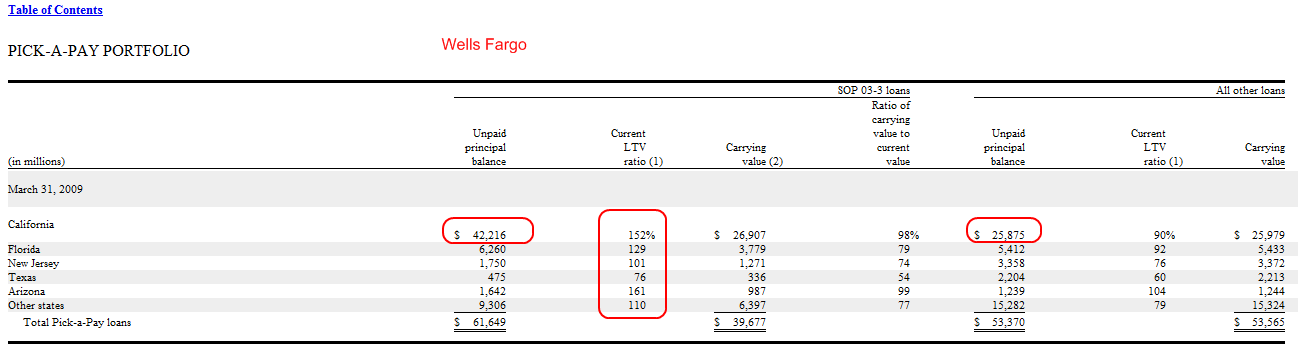
Further, I think I'd want to get out of any Wells positions - their "Pick-A-Pay" portfolio is on the left:

Comings and Goings

ZH has some thoughts ML's rosy REIT outlook. Wilbur Ross is perhaps a little too negative on CRE, which is already off 41% peak-to-date on prices. Is he putting on a massive short via CMBS?

Fortress may be the first new issue TALF deal. DDR may go forward without TALF... and there are several other new issue TALF deals in the works.