Blackstone filed for a $1.25 billion IPO on Hilton. This would be used to "pay down debt" according to the Bloomberg article that is out today, but is a drop in the bucket compared to the $9 billion senior mortgage that was structured in 2010 with a piece in BALL 2010-HLTN, and another ~$10 billion in mezz debt done at the same time. Previous Hilton stories can be found here.
Bloomberg also notes that Blackstone has had two other IPOs in the past year: SeaWorld Entertainment Inc ($807.3mm, April - up 6%) and Pinnacle Foods Inc. ($667mm, March - up 35%).
Thursday, September 12, 2013

How will a lender ever do business in Richmond CA again?
It was reported yesterday that Richmond California has approved the plan to use Eminent Domain to condemn underwater mortgages. ZeroHedge.com has the best review.
We've discussed it in detail previously but the most obvious negative impacts boil down to:
We've discussed it in detail previously but the most obvious negative impacts boil down to:
- Lenders will likely flee the market now that the City has created a new law effectively nullifying centuries of contract law. I certainly would not write a mortgage in a municipality that would invalidate it because the collateral value had declined (shouldn't the borrower post MORE collateral in this case?)
- Borrowing costs to individuals are likely to increase dramatically if any lenders remain in the market. The risk to the Lender just went through the roof, they're going to require compensation to offset the risk. This may come through a rate increase or some innovative product such as a home price protection swap or insurance (not mortgage insurance, but systemic price protection "insurance").
- The risk extends to the city and will make it very costly to borrow money at the municipal level. As the Zerohedge article highlights, this has already happened - the city is going to be mired in lawsuits for decades, but somehow has failed to see the future despite a suit already filed in district court with the first motion hearing next week.
- The ripple effects will damage home prices in the city substantially. The first person who wants to sell their house will discover that there are no buyers (unless they're all cash) because there are no lenders. The lower home prices will likely cause the city to try to condemn additional mortgages as it slowly amputates whatever remaining value there is in the local housing market.
Wednesday, August 21, 2013
LBUBS 2007-C2 AM Shortfall, AJ losses
You'll recall this deal is the one where Orix liquidated a large portion of problem loans at one time last month, creating a boon for credit IOs, but wiping out all the bonds up to the AJ, and 10% of the AJ itself.
This month, shortfalls were back (obviously) and ate into the AM class and undercollateralization led to additional losses to the AJ. Barclays was out with a note that highlighted that the AJ interest shortfall was likely to be permanent at this point.
This month, shortfalls were back (obviously) and ate into the AM class and undercollateralization led to additional losses to the AJ. Barclays was out with a note that highlighted that the AJ interest shortfall was likely to be permanent at this point.
Monday, August 12, 2013
JPMCC 2008-C2 - The Promenade Shops at Dos Lagos
This $123mm loan finally liquidated after going delinquent the same year it was sold to the market in JPMCC 2008-C2, resulting in a >100% loss and wiping out 12 tranches in the process. The property sold for $29.7mm in gross proceeds, but that was only enough to cover the servicer advances, selling costs, and a portion of the ASER. The remaining $10.8mm of ASER was left unpaid.
Barclays has an execellent summary out about it with links to the other big losses in recent months, Silver City Galleria and Tri-County Mall.
For previous stories we wrote on this deal, click here.
And, yes, because this JP deal wins the worst CMBS Deal Evah award, we will once again display an image of JP Morgan's namesake expressing his feelings about the loan.
Barclays has an execellent summary out about it with links to the other big losses in recent months, Silver City Galleria and Tri-County Mall.
For previous stories we wrote on this deal, click here.
And, yes, because this JP deal wins the worst CMBS Deal Evah award, we will once again display an image of JP Morgan's namesake expressing his feelings about the loan.
 |
| When I find the originator at my bank who made this loan, I'm going to gut his belly open like the pig he is (exhibits thrusting motion of knife at hip level) and place his head on a pike out front of the office. -misattributed to J.P. Morgan |
Friday, August 9, 2013
Gansevoort Park Avenue hotel receiving criticism, threats to shut off its liqour license
This is important because it's a big pari passu CMBS loan in CGCMT 2012-GC8 and GSMS 2012-GCJ9.
More importantly they allegedly have naked girls and 24/7 parties at the pool on the roof, and we're sending someone over pronto to confirm this activity.
As reported by CBS .
More importantly they allegedly have naked girls and 24/7 parties at the pool on the roof, and we're sending someone over pronto to confirm this activity.
As reported by CBS .
Wednesday, August 7, 2013
SEC Investigating S&P for 2011 Ratings Snafu
As you'll recall, back in 2011 S&P abruptly pulled ratings from a new issue deal citing "discrepancies in how its methodology was being applied". Then they were radio silent for a year before meekly announcing that the discrepancy was insignificant and they were back to rating deals.
Bloomberg has an article out today that "three people with knowledge of the matter" said that the SEC is investigating how S&P rated a certain CMBS in 2011. I think we can all guess which one that was.
This latest inquiry is separate from the 2/4/2013 suit brought by Justice Department against S&P, which is focused primarily on resi deals from 2004 - 2007.
**Update** For whatever reason two robo-users have chosen this one post to spam with unwanted content in the comments section. It waste a ton of my time deleting them everyday so I'm closing the comments on this one post and reporting the two users. It goes against my general rule of allowing any comments to come in, and not making any changes to posts - even if I make an error I'll leave it, or at least acknowledge it, and then include an updated statement. However, I'm not going to let a robot take over the comments section either. What an arsehole.
Bloomberg has an article out today that "three people with knowledge of the matter" said that the SEC is investigating how S&P rated a certain CMBS in 2011. I think we can all guess which one that was.
This latest inquiry is separate from the 2/4/2013 suit brought by Justice Department against S&P, which is focused primarily on resi deals from 2004 - 2007.
**Update** For whatever reason two robo-users have chosen this one post to spam with unwanted content in the comments section. It waste a ton of my time deleting them everyday so I'm closing the comments on this one post and reporting the two users. It goes against my general rule of allowing any comments to come in, and not making any changes to posts - even if I make an error I'll leave it, or at least acknowledge it, and then include an updated statement. However, I'm not going to let a robot take over the comments section either. What an arsehole.
Monday, July 22, 2013
Extended Stay Hotels - It's baaack!
Some of the largest belly flops following the Great Recession were in the Hotel sector, and interestingly, we're seeing two of those spectacular failures come back into the market this month. Red Roof Inn is out in a new issue deal (which we will publish an update on as soon as it prices), and Extended Stay was in the WSJ this morning as it filed for an IPO.
You'll recall Extended Stay, a 680 property hotel chain, was purchased by Lightstone for $8 billion, went through Chapter 11, and was picked up by Centerbridge/Paulson & Co/Blackstone for $3.9 billion in 2010. The current owners have approximately $3.6 billion in debt part of which is in a 2010 deal.
In the original CMBS loan default, everyone sued everyone - even the special servicers involved ended up suing each other. We posted numerous updates about it as it played out. The potential buyers sued, the creditors sued, the Fed owned a big chunk via Bear Stearns... it was ugly. Of course, the day it first showed up in a deal many CMBS players were scratching their heads wondering how the deal got done in the first place.
You'll recall Extended Stay, a 680 property hotel chain, was purchased by Lightstone for $8 billion, went through Chapter 11, and was picked up by Centerbridge/Paulson & Co/Blackstone for $3.9 billion in 2010. The current owners have approximately $3.6 billion in debt part of which is in a 2010 deal.
In the original CMBS loan default, everyone sued everyone - even the special servicers involved ended up suing each other. We posted numerous updates about it as it played out. The potential buyers sued, the creditors sued, the Fed owned a big chunk via Bear Stearns... it was ugly. Of course, the day it first showed up in a deal many CMBS players were scratching their heads wondering how the deal got done in the first place.
Wednesday, July 17, 2013
Orix liquidations wipe out 10% of LBUBS 2007-C2 AJ
This is the second AAA class in CMBS to experience a loss to-date, and it certainly won't be the last. It also wiped out the B - K classes, paid back interest shortfalls as far down as the K, and paid off A2, AAB, and portions of A3 and A1A.
h/t CrabsofSteel
h/t CrabsofSteel
Thursday, June 27, 2013
CMBS Slow Down
The Rational Realist has a post highlighting the widening treasury curve and a fatter spread demanded by investors have pushed rates on loans out 100 bps the last two months.
Thursday, June 20, 2013
Las Vegas one step closer to using eminent domain to help its citizens violate contract law and break their promises
What happens in Vegas, stays in Vegas, unless you're talking about their underwater home loans. These are agreements that individuals agreed to pay, they posted collateral, and now the collateral is worth less than the loan they wish to reduce the loan amount... wait, shouldn't they have to post new collateral? The current administration doesn't think so, Bill Gross is unsure at best, and North Las Vegas City Council has signed an advisory agreement with Mortgage Resolution Partners, a hedge fund dressed in sheep's clothing, that includes exploring a plan where the City/County would effectively condemn the mortgages of its citizens, forcing the banks to write them off, and then re-issuing new mortgages to the citizens so they can stay in their homes. Of course these losses will be spread to taxpayers, pensioners, and other investors in the mortgage market all across the country and internationally. Originators will likely never lend in that city again, or at best will certainly alter the language of their docs to prevent such action if it is even legal in the first place.
This type of short-sighted plan is a good reason to fire your local politicians. They're wasting your tax dollars on a plan that does not even pass the smell test, and its going to cost you millions in legal fees before it blows up in their faces.
This type of short-sighted plan is a good reason to fire your local politicians. They're wasting your tax dollars on a plan that does not even pass the smell test, and its going to cost you millions in legal fees before it blows up in their faces.
Monday, June 17, 2013
First AJ Loss - CSFB 2005-C2
The winner is CSFB 2005-C2, with the first ever AJ-used-to-be-a-Triple-A loss as a result of a $124mm loss on the $135mm Tri-County Mall. The loan actually fetched $31.6mm in proceeds, but also had $6.9mm of advances and $9.9mm of ASERs to pay back resulting a 91.5% loss severity. The B, C, D, F, and G bonds were completely wiped out, and the AJ took a 5% loss.
This certainly won't be the last AJ to get hit with losses. Loans continue to get worked out with more vigor, and we've also seen an increase in high loss severity workouts in recent months.

This certainly won't be the last AJ to get hit with losses. Loans continue to get worked out with more vigor, and we've also seen an increase in high loss severity workouts in recent months.

Tuesday, June 4, 2013
138 Spring Street (WBCMT 2007-C32) sells at a 3% cap rate?
Rivercrest Realty Investors apparently sold the property for $48.5mm, over twice the outstanding CMBS note of $23.5mm (0.78% of WBCMT 2007-C32). The property has retail at street level and offices upstairs. The DSCR for 1Q 2013 was 1.07 with 85% occupancy. It is not clear if the loan is to be assumed or defeased, but it is in defeasance for the next 45 months.
I suppose this shouldn't be too much of a surprise. SoHo's average retail rents were up substantially during the first quarter with average rents of $850 just 1 block north of this location on Prince Street. And, $850 is old news. In February Prada paid $1,000 psf for the 100 Prince Street 10,000sf store, and at 120 Prince Street, asking rents are purportedly going up to $1,200 psf by end of the year.
I suppose this shouldn't be too much of a surprise. SoHo's average retail rents were up substantially during the first quarter with average rents of $850 just 1 block north of this location on Prince Street. And, $850 is old news. In February Prada paid $1,000 psf for the 100 Prince Street 10,000sf store, and at 120 Prince Street, asking rents are purportedly going up to $1,200 psf by end of the year.
Monday, June 3, 2013
345 Park Avenue South (JPMCC 2004-C3) refinanced
According to a Bisnow email , Citibank provided a $100mm CMBS loan to takeout the $68.9mm loan (6.99% of JPMCC 2004-C3) currently on the property which had a maturity date of 1/1/2015 and 18 more months of defeasance. The sponsor is RFR USA (Aby Rosen and Michael Fuchs). The sole tenant is Digitas, with a lease roll in 11/2021, a couple of years before the new 10-year loan matures.
Saturday, June 1, 2013
Pressure Busts Pipes

No doubt you may have heard that Fannie unloaded about 2 yards of A1A CMBS recently as it joins the ranks of large bailed-out institutions who are looking to take part in the extraordinary structured products rally.
- UBS: WAVE CDOs - May 2012
- AIG: Maiden Lane - February 2012
- Lloyds Banking Group: RMBS - May 2013
- Fannie Mae: A1A CMBS - May 2013
And while we're at it, who could ever forget Merrill's infamous deal with LoneStar back in 2008. I remember as I, a young neophyte in the game at the time, was perplexed by the twenty-cent handle and the fact that MER financed 75% of the deal.
But as you can tell by today's picture at the top of this page, this beloved blog is going to focus on Fannie's particular type of bond that it sold into the market. If you want to know how the sale went, I recommend this rather robust piece by Real Estate Finance Intelligence.
In other words, "price talk for the bonds ranged from low 70s basis points for higher quality items to 200 basis points for less attractive securities."
Today's lesson will be for the newbs and for the intermediates. There is some ground to cover here in terms of understanding what exactly these kinds of securities are and how they came to be. The goal is to understand what Fannie's multifamily loan business is, and then try to grasp the idea of securitizing those loans into the special "A1A' bonds that I mentioned above. Please take a seat and make sure you have your glass of water handy.
The following is a primer I picked up via Fannie and it covers what their multifamily business is. Give it a quick read or you may proceed if you're already familiar:
- Fannie Mae: Multifamily Overview - May 2012
Good, so hopefully now you understand how and why FNM is a MAJOR player in the market. Interesting how in 2008, as multifamily contracted, Fannie and Freddie stepped in to counterbalance the sudden dearth of capital and their market share went from less than 1/2 to nearly 3/4.
"The market share held by Fannie Mae and Freddie Mac (“GSEs”) expanded significantly from less than 40% historically to more than 70% in 2009".
Interesting.
We're halfway there people. The first half of structured-product investing is to understand and make assumptions about the collateral; that being the multifamily loans that serve as the assets for the CMBS bonds. The second half, and dare I say, sometimes the most important, is understanding how much cash will be generated from those assets and how much cash YOU (the individual tranche) is due to receive.
Please remember this important piece from the Multifamily Overview pdf that I linked to above:
- In MBS executions, lenders deliver loans to Fannie Mae in exchange for an MBS that is backed by the mortgage loan.
The A1A class is the
MBS that is backed by the multifamily mortgage loans contributed to the CMBS
trust by the originators (typically banks, such BAML, Wells Fargo, etc).
In a lot of deals, the A1A class is essentially stuffed into the deal and
that tranche carries no guarantee by Fannie Mae, but is instead supported by
subordination from the entire pool of assets in the Trust (including
non-Multifamily assets).
- The A1A Class: The practice of "carving-out" a multifamily tranche started in approximately 1998, and still happens in selected deals today.
- The collateral is split into two groups, and a AAA-rated bond is created that is primarily backed by 100% multifamily loans.
- Freddie Mac and Fannie Mae are the only known buyers of this tranche, and the bond is created to conform to the investment rules specified in their charters.
Seriously, take a look here, as to how this all looks when jammed into the securitization. Notice how in the "Notes" column, it says "multifamily carve-out."
Hopefully that makes a little more sense. But what initially perplexed me the first time I heard of A1As was why they were there to begin with and also, if they received credit enhancement from the subordinate bonds in the deal? In most cases, they do.
- In response to investor worries about falling subordination levels in CMBS conduit/fusion deals, dealers started to break up the triple-A rated class into super-senior, "mezzanine," and "junior parts. In the structure shown in Figure 3, classes A1, A2, A3B, A3FL, A4, ASB, and A1A have 30% credit support from subordination and are called "Super Duper Seniors."
Basically, since Fannie and Freddie are the only real buyers of A1A bonds (and hence, they finance the multifamily housing collateral), these particular tranches are made AAA in order to protect Fannie and Freddie from default risk. Pretty good trick.
Do remember however that:
- Because of its position on the capital structure, if there are defaults in the multifamily loans, generally the bond will get cash from other property types as well, so the name “multifamily carve-out” can be slightly misleading.
- Also, if other property types default, cash may be taken from the “multifamily carve-out” to help make other AAA rated bonds whole.
Honestly, a round of applause to Nomura for consistently doing a good job on structured products primers. Cheers.
Hopefully the Real Estate Finance Intelligence article makes more sense at this point. I suggest you give it another look.
~ Jingle Male
Tuesday, May 21, 2013
The Gloves are Off (Seagram Building Pt. 2)
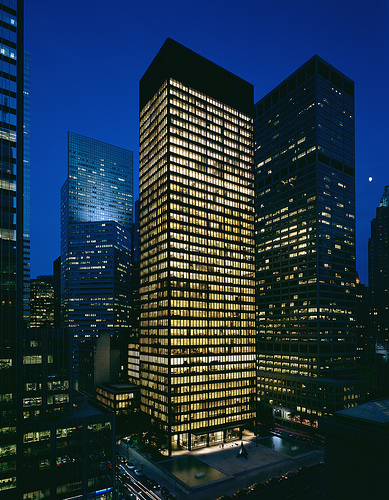
Reuters drops some nuggets of gold in this article but for the sake of brevity, and my 9am deadline, I'm going to paste the relevant pieces. This is in regards to last week's post on CGCMT 2013-375P.
The Pricing
- While this type of rating agency sniping has been going on over the past two years...it has never been timed in this way, according to industry participants.
- "The underwriters clearly emptied the old bag of tricks on this one, as far as crisis-era underwriting goes, and the agencies [fell for] them," said the head of CMBS investing at one of the biggest asset managers in the country.
- Those tricks included re-measuring the building, lowering management fees in order to minimize projected expenses, and creating an 'optimizing' structure that pushes as much away from the mezzanine debt into the securitization at the Triple B minus level.
- ...the Triple A portion of the US$572.9m transaction was increased at pricing on Thursday from US$75m to US$209m. Spreads on the most subordinate pieces widened considerably, however. The deal was originally US$439.75m.

The Structure
- The underwriters securitized the entirety of the so-called subordinate, or junior, portion of a US$782.75m commercial mortgage on the Seagram building.
- However, they only securitized part of the senior portion, known as the A loan, leaving the flexibility to increase the Triple A piece in the bond transaction.
- he remaining unsecuritized portion of the A loan will be put into an upcoming multi-borrower CMBS conduit.
The Assumptions
- ...they generally thought that the issuer's initial projected numbers regarding net operating income, occupancy, expenses, structure, and other metrics on the top-notch building were way too aggressive.
- Therefore, each agency assumed a steep haircut on the building's net cashflow and valuation in order to arrive at its Triple A enhancement levels.
- Kroll assumed 17.9% less than the issuer's net cashflow and 46.7% below the appraiser's valuation...
- Moody's undercut by 10.7% the underwritten cashflow.
- In January, Fitch rated a CMBS titled GSMS 2013-KYO, linked to six hotels in Honolulu, which was said to have used pro forma underwriting;
- In response, the head of CMBS at Fitch, Huxley Somerville, said that Fitch used a highly stressed cashflow assumption on the deal backed by the Kyo-Ya hotel portfolio
- The underwriter, Goldman Sachs, used pro forma assumptions to calculate so-called Revenue Per Available Room (RevPAR), presenting a projected cashflow of US$174.4m.
- ..last November Fitch gave Triple A grades to a deal linked to an office building, 1290 Ave of the Americas, with pro forma projections.
- Similarly, on the deal backed by a loan on 1290 Ave. of the Americas in Manhattan, Somerville said there was a US$10m leasing reserve to cover future leasing costs
- the underwriter's cashflow was US$94.4m, while Fitch assumed US$89.9m.
then I'll start to get worried.
~Jingle Male
Wednesday, May 15, 2013
Stuy Town Rent Increases
Checked in on Stuy Town this morning, there were tenant protesting notes they all received under their doors last night stating rents were being increased 21% in two weeks. Sounds like everyone got them. Payup or move out was the message...
Monday, May 13, 2013
Nerd Fight!

Fitch does not seem to agree with Kroll's rating of a $782.75M, interest-only mortgage that was stuffed into the recent CGCMT 2013-375P deal. For the uninitiated, Fitch seems to believe that the underwriting assumptions used to finance RFR Realty's acquisition of the Seagram Building is a bit aspirational, to say the least.
Basically:
"--2010: $53,560,729 (average occupancy of 96.9%);
--2011: $56,745,150 (average occupancy of 96.6%);
--2012: $54,078,388 (average occupancy of 94.4%).
This compares to the issuer's NOI of approximately $74 million and average occupancy assumption of 96.7%."
Citi and Deutsche underwrote this one with about $20M in pro-forma income. That is, the banks assumed that the property's earnings would increase ~37% via the following:
"--$10.2 million from the mark to market of rents assuming $135 psf for floors 2-12, $145 psf for floors 13-38 and $125 psf for the retail space;
--$7.8 million from the lease up of vacant space from 90.2% to 96.7%; and
--$2.2 million from a recent re-measurement of the building increasing the total sf to 858,000 sf."
I'm in the middle on this one. On one hand I'd like to believe that Fitch has a point and is acting prudently but on the other hand, it seems as if they're still trying to make amends for missing some of the market tops that occurred in 2006 and 2007. Not sure if Fitch is being proactive or reactive.
Fitch provided preliminary feedback of $510 million at investment grade and was not asked to rate the transaction.
But despite any butt-hurtness on the part of Fitch, I take a look at KBRA's assumptions and also the mezz jammed into this deal and it does make a Jingle Male wonder:
 |
| Right-click and select "View Image" |
~Jingle Male
Subscribe to:
Posts (Atom)

 Posts